Double-Edged Sword
Indonesian Personnel in the Royal Netherlands Navy
During the two decades between the world wars, many navies struggled to maintain appropriate capabilities to accomplish national objectives. Mass obsolescence of ships from World War I, and the changing tactics brought about by advances in technology, left many navies unprepared for the rapidly evolving geopolitical situation of the 1930s. The Royal Netherlands Navy (Koninklijke Marine, KM) faced a variety of serious problems including inadequate defense budgets that left it with too few ships; obsolete vessels kept in service for lack of modern ships; an underdeveloped naval air arm; widely dispersed units in Europe, the Caribbean, South America, and Southeast Asia; and uncertainties about the number and reliability of its personnel.
During the interwar period roughly two thirds of the KM’s ships were stationed in the Netherlands East Indies (NEI). Netherlands naval personnel served in the NEI for a few years at a time until rotated back to Europe. Multi-year deployments in a tropical climate, so far from home, were not appealing to large numbers of Netherlands citizens who might otherwise have joined the KM. Budgets were also a consideration for force planning, as money spent on personnel for pay, food, health care, housing, and uniforms meant less money to build new ships. One solution to the KM’s problems of lack of money and lack of sailors was to recruit indigenous sailors from the NEI. While enlisting indigenous sailors could add several thousand men to the KM’s ranks who would not find serving in the NEI to be a climatic or familial hardship and who could be paid less than a European, use of Indonesian sailors had numerous and important disadvantages. These included possible political unreliability, linguistic and religious differences that created a lack of unity, and low education levels that hindered the ability to train men for the more technically demanding ratings. The KM, already small in relation to the area it needed to defend, was even less capable than it might appear on paper due to its personnel practices in the archipelago.
The NEI, today’s Indonesia, consisted of approximately 13.000 islands inhabited by a large and culturally diverse population. Colonial-era Dutch sources described indigenous personnel by what island they came from (e.g., Java, Madura, Ambon, etc.) and/or what religion they practiced (Islam, Christianity, etc.). Widespread acceptance of the archipelago as Indonesia waited until after World War II when the Netherlands granted independence to the NEI in 1949 as the Republic of Indonesia. For convenience, this article uses the term Indonesian to mean any indigenous person of the then NEI. In some sections of the paper, particularly in part two, the analysis explains how people from the Moluccas Islands were treated differently than other people from what is today Indonesia.
This two-part article examines the KM’s longstanding practice of using indigenous sailors in its NEI squadron. It argues that the Netherlands decision to use Indonesian personnel in its naval forces in the NEI resulted in a peacetime advantage in terms of numbers of sailors on duty but ultimately a disadvantage in times of crisis when Indonesian sailors acted against the interests of the Netherlands state. In part 1 the article briefly traces the Netherlands decision to begin and then expand indigenous recruitment, including the internal debate among KM officers about this practice. The landmark event in KM history during the 1930s, a 1933 mutiny on the armored ship Hr.Ms. De Zeven Provinciën that trained Indonesian personnel, continues the story. In part 2 (December 2024 issue) the article then turns to the war years when manpower concerns became even more acute and concludes with the post-war independence movement and the gradual ending of KM use of indigenous sailors.
Sources on indigenous personnel in the Netherlands armed forces
The global nature of World War II and the enormous manpower demands it imposed on the belligerent states resulted in the United Kingdom, France and the Netherlands among several countries deploying large numbers of colonial subjects on active military service. Indigenous personnel were most numerous in the land forces, but naval forces should not be overlooked. Outside of articles in a professional journal, there are few published sources that focus on the use of Indonesian sailors in the former NEI. Among these are a very short book and an announcement of that book in a scholarly journal.[i] These two sources broadly consider the presence of Indonesian sailors in the KM from 1915-1965 but emphasize men from the Moluccas Islands including Ambon Island. The book contains brief anecdotes by surviving veterans about their service in the war and immediate post-war eras rather than giving a methodical explanation of the KM’s use of indigenous personnel. There is also an unpublished university thesis that assesses the KM’s use of Indonesian personnel from 1870 to 1914. The thesis concerns seven aspects of the working conditions (recruiting, food, pay, uniforms, sickness, training, and pensions) experienced by indigenous sailors, noting changes as a result of successive new naval regulations.[ii]
‘Competition for recruits between the Netherlands metropolitan army, the KNIL, and KM was intense’
However, there are sources that examine the role of Indonesians in the Netherlands colonial army, and so by extension something can be learned of the Netherlands attitudes and policies toward indigenous service personnel.[iii] The Royal Netherlands Indies Army (Koninklijk Nederlands-Indisch Leger, KNIL) made extensive use of indigenous enlisted men for fundamentally the same reasons as the KM, a lack of men from the Netherlands.[iv] Competition for recruits between the Netherlands metropolitan army, the KNIL, and KM was intense, due to a small national population and distaste for military service among young men.[v] Between 1861 and 1918, the number of European enlisted men in the KNIL declined by 49% while the number of Indonesian enlisted men rose by 103%. The Netherlands saw the different ethnic groups of the Indonesian archipelago as having very different potentials for military service. Men from the eastern islands of Ambon, Timor and the Menado area on the Minahassa peninsula of northern Celebes (today Sulawesi), collectively called Ambonese by the Dutch though the islands were a considerable distance from each other, were seen as highly capable soldiers. Many of these peoples were Christian and assumed to be completely loyal to the Netherlands. Far more numerous but viewed less favorably as soldiers were the Javanese.[vi]
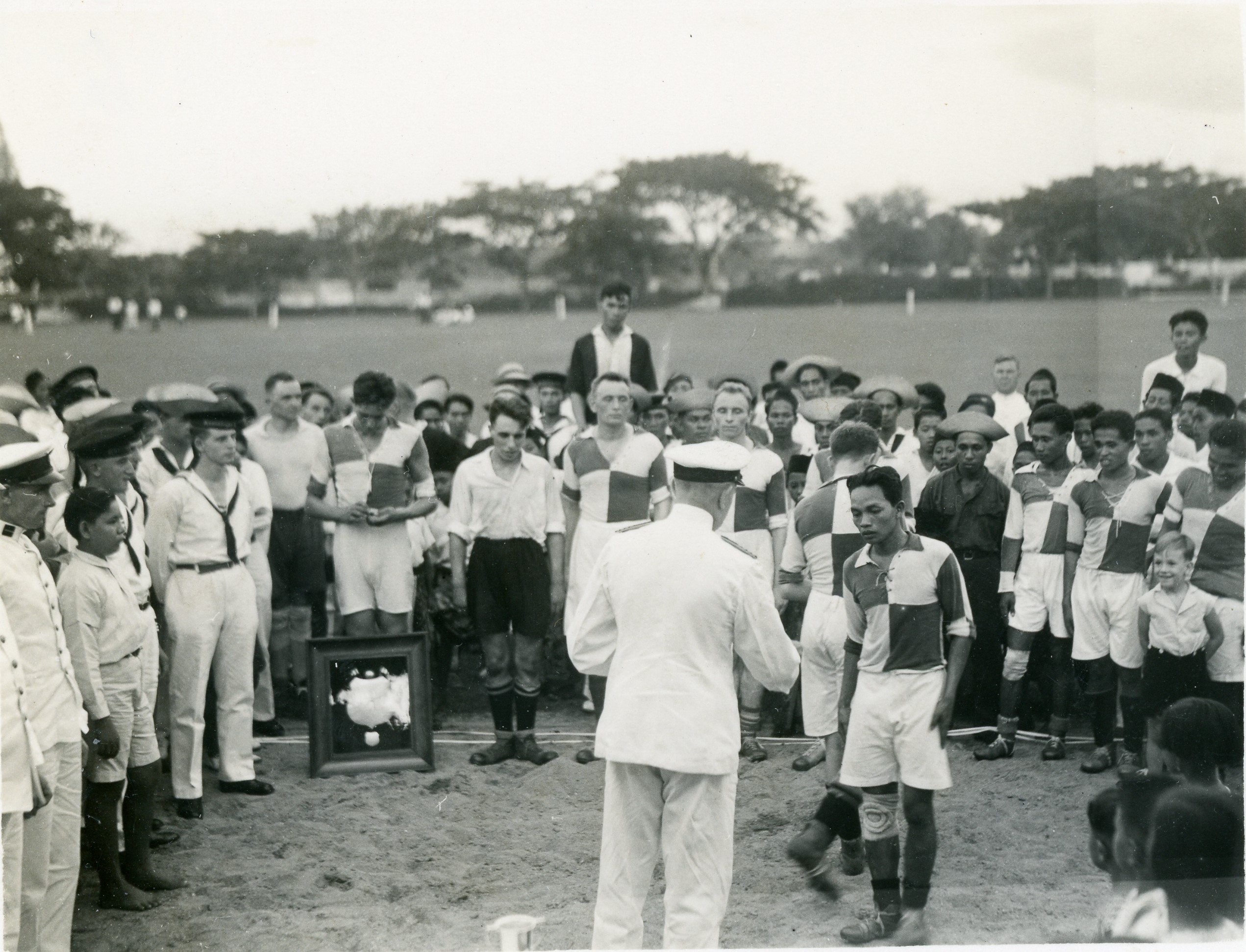 Captain H.J. van der Stad, commanding officer of the Oedjong barracks at Surabaya, awards individual prize medals to members of the winning football team circa November-December 1934 (Image courtesy of Jan Klootwijk)
Indigenous sailors as manpower solution
The Netherlands maintained naval forces in what is today Indonesia for about 140 years.[vii] By 1850 the KM already had 500 indigenous sailors.[viii] Around 1873 the idea emerged to replace European sailors with Indonesians so during the 1870s, Netherlands naval forces were slowly enlisting small numbers of Indonesians.[ix] The early focus was on replacing European sailors serving as stokers in the engine rooms with indigenous sailors. In 1885 the KM established a separate administrative entity for the Indonesian sailors, the Korps Inlandsche Schepelingen.[x] From 1887 onward, the KM used Indonesian sailors as cooks, servants, watchmen, and assistants in hydrographic surveying. While the goal of the KM was to limit the Indonesians to one third of the total naval personnel in the NEI, this limit was surpassed for reasons of cost, availability, and the desire to shield European personnel from the health impacts of hazardous jobs. Indigenous sailors were paid less than Europeans with the justification that Indonesians did not have the same expenses as Europeans.[xi] Thus, in the eyes of the Netherlands government a difference in pay was not unfair.
From the early 1900s the KM continually experienced a shortage of personnel. Various solutions to the manpower crisis were considered, one of which was to conscript young men and create a ‘militia navy’.[xii] However, the government was reluctant to abandon a mostly volunteer force. A second solution could have been to enlist citizens of other countries as was done by the KNIL during the nineteenth century.[xiii] The KM did not do this. The third solution was to enlist indigenous men. Forced to deal with a shortage of crew, in March 1913 an experiment was launched to recruit Indonesians, who up to then had served only in very minor positions as batmen to naval officers and the like, to become what were dubbed ‘war sailors’ in the auxiliary fleet. The experiment held out the extra advantage that, if it were successful, Indonesians could take the place of some of the European sailors, who considered their long tour of duty in the colony an ‘inevitable disaster.’[xiv] Arguments at this time against using Indonesian sailors included that they were lazy, lost their composure during times of stress, or were too promiscuous to serve aboard a ship for extended periods.[xv] Another source noted the frequency of desertion.[xvi]
Language training for KM officers and men would be necessary for effective leadership of Indonesian enlisted personnel. However, teaching Malay to student officers at the KM naval academy ended in 1904 and did not resume until 1913.[xvii] Indonesians could enter the training school at Makassar without speaking Dutch, a policy that ended in 1928.[xviii] So for almost a decade, many European officers in the NEI had no formal language training in Malay and enlisted men who attended the training school might not speak Dutch. This problem could be overcome by having bilingual crew members translate orders or learning common commands but was not ideal.
While the KM was willing to use indigenous personnel, there was a strict segregation at multiple scales. Indonesian personnel did not ever serve in Netherlands home waters. If a ship (such as the cruisers Hr.Ms. Java and Hr.Ms. Sumatra) were due to sail to the Netherlands for a refit, indigenous personnel would be replaced with European sailors before the ship left the Indies.[xix] Indonesian sailors were berthed and messed separately from European sailors on surface ships, which had the space to accomplish this. On the flotilla leader Hr.Ms. Tromp, crew berths were labeled as indigenous or European, part of a strict social hierarchy.[xx] On submarines, lack of space prevented separate berths.[xxi] Even housing for those Indonesian personnel assigned to shore bases at Soerabaja was segregated, with these men and their families living in the Palembangstraat neighborhood.[xxii] The segregation of Indonesian personnel from European personnel was further advanced by the creation of an administrative status for Indonesian sailors. Indigenous personnel belonged to the Korps Inlandsche Schepelingen. In March 1922, Indonesians working as stewards and cooks were transferred from that entity to the newly established Korps Inlandsche Bedienden.
‘Continued growth of indigenous personnel in the KM was not without controversy’
The decade prior to Netherlands involvement in World War II saw increasing numbers of Indonesian personnel in the KM.[xxiii] In 1930, there were more Indonesian sailors (2,352) than European sailors (1,900) in the NEI.[xxiv] By 1933, the number of indigenous sailors had risen to 2,500.[xxv] However, the continued growth of indigenous personnel in the KM was not without controversy.
The debate within the KM officer corps
While the KM steadily expanded the number of Indonesian sailors in its ranks and broadened the types of ratings open to local men, there were increasing questions being raised in the fleet about the value of indigenous personnel. Numerous articles in Marineblad from 1910-1919 and 1929-1934 indicate that the issue of indigenous personnel was of great interest or concern at the time. Twenty-three officers wrote 30 commentaries about various aspects of Indonesian personnel. Most of these officers held the rank of lieutenant or lieutenant commander, so were men whose assignments were likely to have included recent service afloat in close contact with indigenous sailors. Three of the commentaries were written by officers who would serve as admirals in the NEI just before or during World War II, two of whom (H. Ferwerda and C.E.L. Helfrich) were the commander in chief of the NEI fleet. One article from 1929 strongly criticized the use of Indonesian personnel and led to sixteen responses published in the following three issues, indicating that this author had raised a sensitive topic in the fleet.[xxvi]
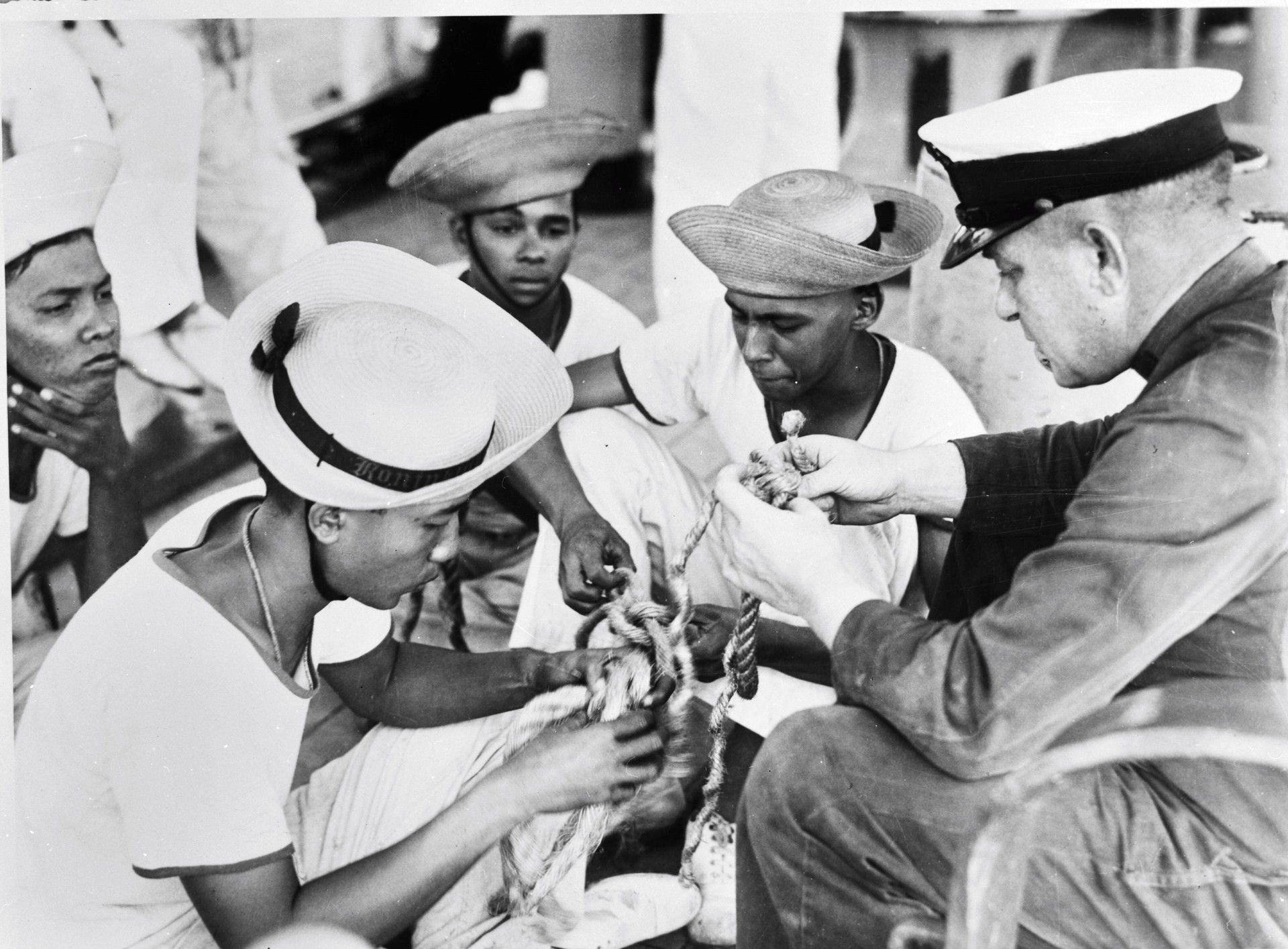 Indonesian recruits learning to tie knots from a petty officer. The sailors wear the bamboo hats only worn by personnel stationed in the NEI (Nationaal Archief 2.24.01.04, ANEFO London series | 935-0017)
The advantages of using Indonesian sailors were seen by these officers as primarily financial. Lower pay for local men allowed the KM to enlist more sailors than if only Europeans were recruited. In the tight financial circumstances of the day, this was no small consideration. The health impacts of naval service were also recognized. Using Indonesians as stokers and other engine room staff would lessen the health consequences for Europeans. Though not directly addressed by the Marineblad commentaries, use of Indonesians would reduce the cost to rotate men back and forth between Europe and Asia on passenger ships. Indonesians would also not see the tropical climate as a hardship.
The Marineblad commentaries collectively include a very long list of disadvantages of using indigenous sailors. Each author addressed a slightly different mix of drawbacks, depending on that officer’s career path, and certainly reflected the contemporary cultural prejudices in a stratified colonial society. Among the criticisms were: not strong enough to lift a 12cm or larger shell; not tall enough to load large shells in a ship’s main armament; low education levels; inability to learn and retain information needed in skilled ratings like machinist or torpedoman; poor understanding of the Dutch language; tendency to panic when faced with unexpected situations; lack of initiative; unwillingness to give orders to lower ranked Europeans; possible political unreliability due to nationalist or communist sympathies. The most severe criticism was provided by the officer then serving as commander of the destroyer flotilla, Commander H. Ferwerda, who listed thirteen drawbacks including most of the above points but adding seasickness and petty officers who were unsuited to be non-commissioned officers.[xxvii]
Most of the commentaries provided suggestions about ways the KM could improve the situation. These included raising the standards for entering the KM; expanded training using different methods than used for European sailors; limiting promotion to leading seaman (korporaal) instead of allowing men to advance to petty officer (sergeant); limiting the ratings open to Indonesians to exclude combat positions and/or the more technically challenging ratings; reducing the total number of indigenous sailors in the KM and on any one ship; assigning Indonesians to shore duty or support vessels like minesweepers instead of front-line warships like cruisers, destroyers and submarines; not assigning Indonesians to crucial positions like the diving planes on a submarine; encouraging officers to show confidence in Indonesians and demonstrate respect for them; teaching conversational Malay and the basics of island cultures and religions to officers. Several of the commentaries attempted to describe the essential culture and outlook of an indigenous sailor, usually to support an argument about their potential suitability for naval service.[xxviii]
The overall opinion of the commentary writers was a mix of neutrality and opposition. A few officers made blanket condemnations of indigenous personnel while others recognized that some Indonesians served capably or were suitable for specific less-challenging assignments. One officer offered this perspective: ‘…it is not a solution to say, ‘the native is not equal to the European, therefore get rid of the native.’ We have to remain practical and between two wrongs choose the least harmful.’[xxix] Several of the writers felt that the KM had approached or even crossed a threshold, where the sheer number of indigenous personnel threatened the utility of the KM and made it questionable whether it actually was a Netherlands force. The use of indigenous personnel ultimately boiled down to the issues of quality versus quantity, and combat readiness. Enlisting Indonesian sailors allowed the KM to have more total personnel and thus crew a larger number of ships. However, the numerical benefit was offset by a reduction in skill, experience, and reliability, which ultimately lowered the KM’s combat potential. Another officer offered a very blunt assessment. ‘If one wants to turn the Navy in Indië into a tiny police fleet, just suited for opium hunting, scourging the kampongs and fighting piracy, and even unsuited for the basic requirements of neutrality enforcement, then we can safely proceed with enlisting these natives.’[xxx]
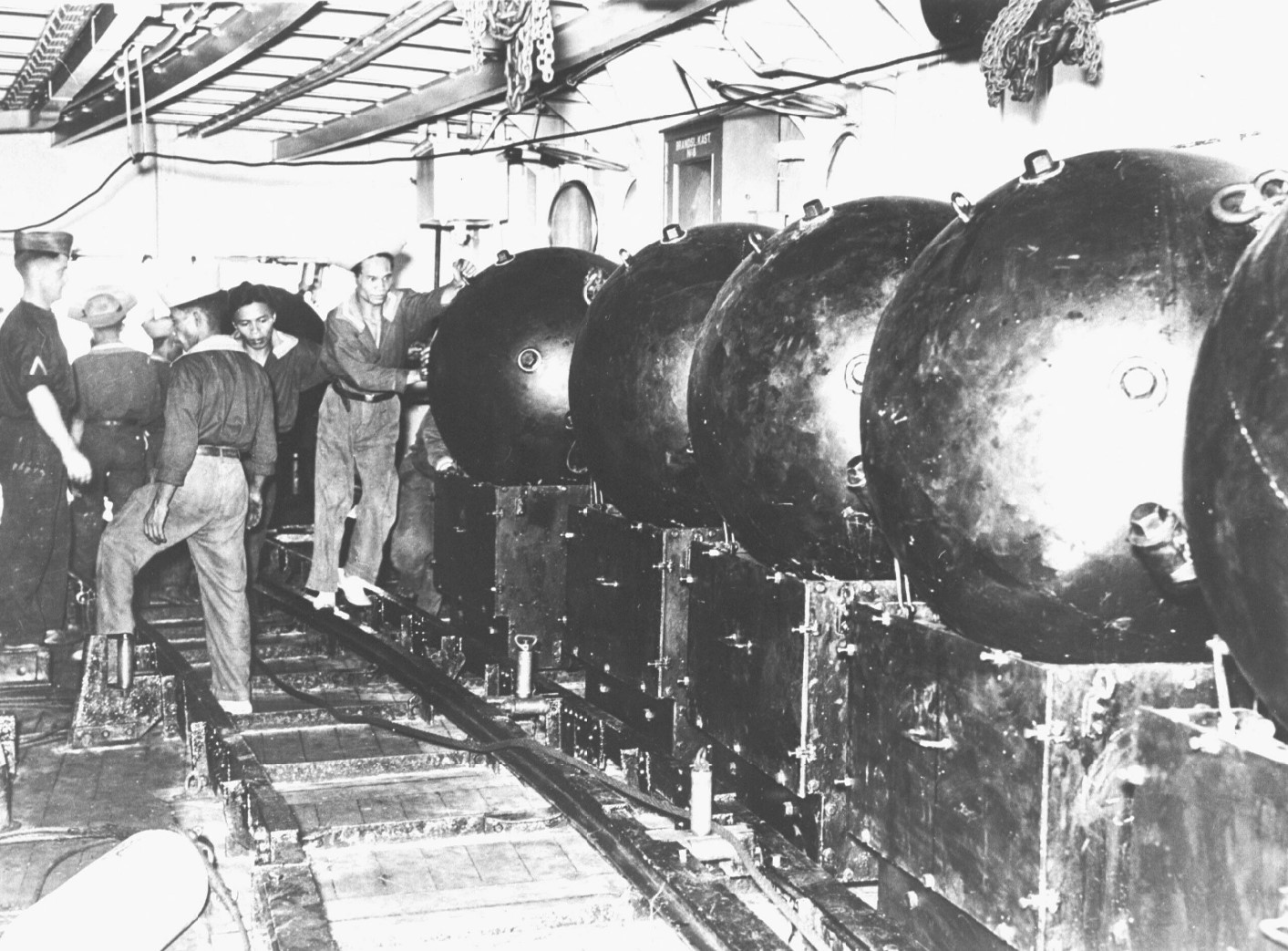 Several Indonesian sailors supervised by a European leading seaman attend to mines aboard a minelayer, with launching rails visible below the units, 1941 (collection NIOD | 54508)
Collectively, the commentaries published in Marineblad, especially those between 1929 and 1934, provided both insight and warning to the KM leadership about its NEI fleet. Subsequent events in 1933, 1942, and 1945-1949 would show that the skeptics among the commentary writers, particularly those who mentioned reliability or nationalist sympathies, had legitimate concerns.
Mutiny and increased caution in the KM
The issue of reliability of Indonesian personnel came to a head in February 1933 when the crew of the armored ship Hr.Ms. De Zeven Provinciën mutinied over pay cuts and discrimination.[xxxi] On 4 February 1933 while the ship was at anchor off northern Sumatra and some of the officers were on shore, the crew seized control of the ship. While the general rule was that two-thirds of a ship's crew was to be European, the vessel was being used for sea training for Indonesians and thus had a crew that was only one-fifth European.[xxxii] One source reports that the crew consisted of 16 European officers, 54 European enlisted men, and 195 indigenous enlisted men. Of the ten petty officers who remained loyal to the officers, seven were European and three were Indonesian.[xxxiii]
The mutineers sailed the ship toward the main naval base of Soerabaja (today Surabaya) on the island of Java with the intention of protesting the 7% pay cut of 26 January and demanding the release of other Indonesians under detention there. The commander of the NEI fleet at the time, Vice Admiral J.F. Osten, ordered a flying boat of the naval air service to drop a bomb near the ship as a warning to the crew. The bomb landed instead just aft of the bridge where the mutineers happened to be clustered. The bomb killed 23 men and wounded many more, the majority of whom were Indonesian. The crew promptly surrendered. Of the 165 mutineers, 134 (81%) were Indonesians. The KM was particularly surprised by this mutiny as many of the mutineers were Ambonese, the indigenous group considered most reliable in Netherlands military service.[xxxiv] The mutiny had profound but somewhat short-lived consequences for the KM’s use of indigenous personnel. By mid-February 1933, the KM had arrested 700 Indonesian sailors.[xxxv] Another source states the KM had a personnel shortage of 100 European and 700 indigenous sailors.[xxxvi] As a consequence of the De Zeven Provinciën mutiny, the KM stopped enlisting Indonesian personnel and closed the training school for indigenous sailors less than two weeks after the mutiny. The exception to this ban was for servants (stewards). The KM continued to use Indonesian sailors who had not been dismissed for political unreliability.[xxxvii] Recruitment of indigenous sailors resumed in May 1937 and the training school was reopened.[xxxviii] Hr.Ms. Soerabaja, the renamed De Zeven Provinciën, was used for sea training for the indigenous sailors.
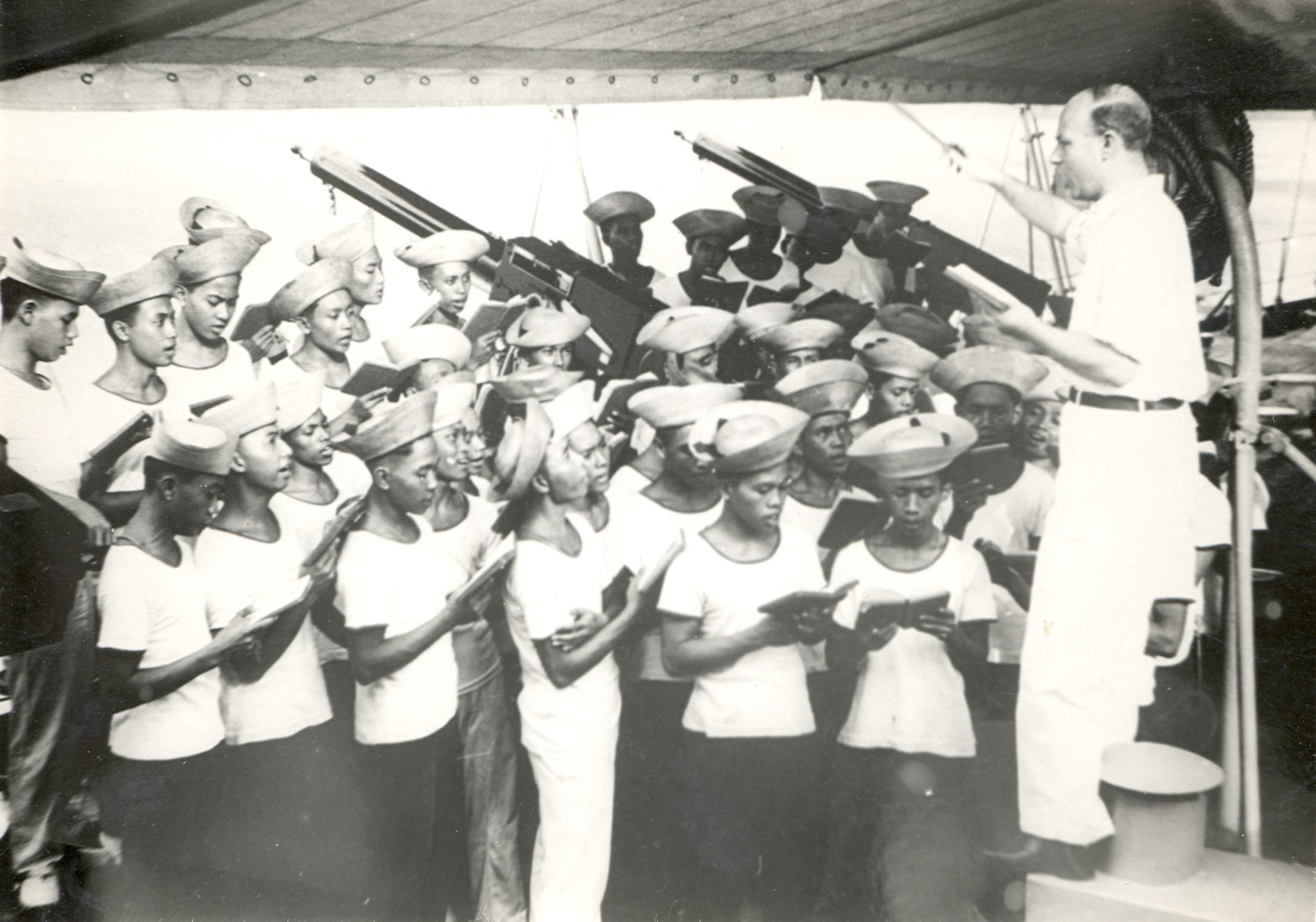 Indonesian sailors singing aboard the light cruiser Hr.Ms. Sumatra circa 1941. Note the two single Vickers-Armstrong 40mm anti-aircraft guns in the background (collection Marinemuseum, Den Helder | FT02478)
Preparation for war in the Pacific
Due to enduring and serious personnel shortages, on 28 August 1939 the KM decided to prohibit indigenous sailors from leaving the service at the end of the enlistment. The KM did not conscript Indonesians, but it did expand recruitment of them after May 1940 and it raised pay levels. Because of the small size of the European population in the NEI, by mid-1940 the colonial government began to consider the indigenous population as a necessary component to the overall defense of the islands. The aviation branch of the KNIL began training qualified indigenous men for technical jobs and even flying positions. In late May 1940, after the German occupation of the Netherlands, the KM was permitting former naval personnel who had been honorably discharged no later than 1 January 1935 to return to duty.[xxxix] This included Indonesians. By March 1941 the armed services encouraged the islands’ governor to institute compulsory military service.[xl] This might have been possible if the Indonesians were granted political rights in exchange for accepting conscription, but the government did not act upon the military’s recommendation.[xli]
‘Indonesians could serve as a boy, seaman, corporal or sergeant but seldom advanced to the most senior grade of enlisted sailor, sergeant-major’
On the eve of hostilities, the KM had broadened its use of Indonesian personnel well beyond strictly support roles such as cook, food supply assistant, steward, barber, clerk, musician, and sick berth attendant. It allowed indigenous sailors to hold a variety of ratings including seaman, stoker, mechanic, aircraft repairman, carpenter, and radio operator. Indonesians were particularly common among the stokers, a demanding job that the Europeans saw as suitable for non-European personnel. Low literacy levels relegated most Indonesians to unskilled positions, often on shore duty. Indonesians could serve as a boy, seaman, corporal or sergeant but seldom advanced to the most senior grade of enlisted sailor, sergeant-major. All ratings for Indonesians were preceded by the term inlands or inheems.[xlii] Most Indonesian personnel had names easily recognizable as indigenous, often going by a single name, but some Indonesians had names that would be hard to determine the ethnicity of which were it not for the hint contained in the rating.
At the beginning of World War II, there were no Indonesian naval officers. At least one Indonesian was under reserve officer training, but this was to prepare him to be a fisheries inspector. Indonesians were eventually allowed to enter the naval academy in 1940, following its reestablishment at Soerabaja after the German occupation of the Netherlands in May of that year.[xliii] The directory of naval academy graduates lists six Indonesian midshipmen, four from the 1940 entering class and two from the 1941 entering class.[xliv] Two were designated as training to become engineering officers while the others were designated to become administrative officers. Note that none of the six were to become executive officers, which could make them eligible to command a ship. One of the engineer midshipmen escaped the NEI in March 1942 and served part of the war as an agent for the Netherlands Forces Intelligence Service (NEFIS) while four midshipmen were prisoners of the Japanese. In addition to a few Indonesians who entered the naval academy and thus were eligible to become career officers, other men were permitted to become reserve officers. Three of these were part of the combined army/navy flight training school that evacuated in February 1942 from Java to Australia and then in April 1942 to the United States.[xlv]
Mark C. Jones is a historian and geographer in Concord, New Hampshire, United States. He has published multiple articles and book reviews about the European Allies, several of which concern the KM. This article is a shortened and modified version of the author’s ‘Double-edged sword: Indonesian personnel in the Royal Netherlands Navy,’ Journal of Military History 88, no. 3 (July 2024): 714-740. Part 2 appears in the December 2024 issue.

Noten
[i] Herman Keppy, De laatste inlandse schepelingen: Molukkers in dienst van de Koninklijke Marine 1915-1965. (Amsterdam: Focus, 1994). By the same author, “Book announcement, De laatste inlandse schepelingen” Cakalele 8 (1997): 109-16.
[ii] Jeroen Leeuwensteijn, Inlandse schepelingen op de Nederlandse oorlogsvloot in Nederlands-Indië 1870-1914. Doctorandus thesis, Leiden University, 1998. Copy available from the Netherlands Institute of Military History, The Hague.
[iii] Jaap de Moor, “The recruitment of Indonesian soldiers for the Dutch colonial army, c. 1700-1950.” In David Killingray and David E. Omissi, eds., Guardians of Empire: The Armed Forces of the Colonial Powers c. 1700-1964. pp. 53-69. (New York: St. Martin’s, 1999).
[iv] M. Bossenbroek, “The living tools of empire: the recruitment of European soldiers for the Dutch colonial army, 1814-1909,” Journal of Imperial and Commonwealth History 23, no. 1 (1995): 26-53.
[v] Bossenbroek, “The living tools of empire,” p. 34.
[vi] G. Teitler, “The mixed company: fighting power and ethnic relations in the Dutch Colonial Army, 1890-1920.” In Karl Hack and Tobias Rettig, eds., Colonial Armies in Southeast Asia. pp. 154-68. (New York: Routledge, 2006). See table 6.1 on p. 155 for a detailed breakdown of the number of Indonesian soldiers by ethnicity and corps within the KNIL at roughly ten-year intervals from 1861-1918.
[vii] A.M.C. van Dissel, “Embarking on a new course: personnel, ships and administrative reforms in the Royal Netherlands Navy, 1814-1914.” In P.C. van Royen, L.R. Fischer and D.M. Williams, eds. Frutta di Mare: Evolution and Revolution in the Maritime World in the 19th and 20th Centuries. pp. 101-14. (Amsterdam: Batavian Lion International, 1998).
[viii] J.P. Nieborg, Indië en de zee: de opleiding tot zeeman in Nederlandse-Indië 1743-1962. (Amsterdam: De Bataafsche Leeuw, 1989), p. 73. Chapter 6, pp. 73-93, “De Indische Militaire Marine en de Koninklijke Marine” provides a wealth of detail about the Netherlands’ attempts to train Indonesians for naval service.
[ix] Leeuwensteijn, Inlandse schepelingen op de Nederlandse oorlogsvloot in Nederlands-Indië 1870-1914, p. 11.
[x] P.M.H. Groen, A.M.C. van Dissel, M.A. Loderichs, R. Limpach, and T. Brocades Zaalberg, Krijgsgeweld en kolonie: Opkomst en ondergang van Nederland als koloniale mogendheid, 1816-2010 (Amsterdam: Boom, 2021), p. 197.
[xi] Leeuwensteijn, Inlandse schepelingen op de Nederlandse oorlogsvloot in Nederlands-Indië 1870-1914, p. 28, says pay for Indonesians was 1/3 less than for Europeans.
[xii] T.A. Onderwater, “De wens om de Koninklijke Marine tot een militiemarine om te vormen tijdens de Eerste Wereldoorlog.” Marineblad 128, no. 1 (2018): 22-27.
[xiii] Bossenbroek, “The living tools of empire,” p. 41.
[xiv] C. Van Dijk, The Netherlands Indies and the Great War, 1914-1918 (Leiden: KITLV, 2007), p. 97.
[xv] Van Dijk, The Netherlands Indies, pp. 97-98.
[xvi] C.L.M. Bijl de Vroe, “Over inlandsche schepelingen.” Marineblad 25 (1910-11): 409-16, data table on desertions on p. 412. This article also gives details of when certain ratings were opened to Indonesian sailors.
[xvii] Groen et al., Krijgsgeweld en kolonie, p. 224.
[xviii] G.J.A. Raven, “That expensive asset: a short history of Netherlands naval personnel.” Revue Internationale d’Histoire Militaire 58 (1984): 167-85, p. 180.
[xix] Email message of 17 January 2015 from Rear Admiral A.P.E.J.J. Besnard, RNLN retired to author. Pierre Besnard spent part of his childhood in northern Sumatra and was a junior officer during World War II.
[xx] G.H. Kleinhout, J.C.I. Landegent, J. Mulder and C. Sybesma. De Tromp en haar Trompers. (Emmen: Lanasta, 2003), p. 123.
[xxi] D.H. van Velden, Fremantle's Forgotten Fleet: A Social History of the Royal Netherlands Navy in Western Australia, 1942-1945 (Leiden: thesis, Leiden University, 1999), pp. 54 and 88.
[xxii] Keppy, De laatste inlandse schepelingen, p. 35.
[xxiii] Netherlands Institute of Military History (hereafter NIMH), 064 Marine Voorlichting (MARVO), 68 De Koninklijke Marine en het Korps Inlandsche Schepelingen. This roughly forty-page book published in 1929 gives an overview of the KM’s recruitment, training, promotion, and assignment of Indonesian personnel.
[xxiv] A.M.C. van Dissel, “Tropenjaren: de Nederlandse zeemacht in Aziatische wateren (1816-1962).” In J.R. Bruijn and C.B. Wels, eds., Met man en macht: de militaire geschiedenis van Nederland, 1550-2000. pp. 245-84. (Amsterdam: Balans, 2003), p. 272.
[xxv] G.J.A. Raven, "The mutiny on HNLMS De Zeven Provinciën: unions and recruitment in the Royal Netherlands Navy, 1890-1950." In William R. Roberts and Jack Sweetman, eds., New Interpretations in Naval History (Selected Papers from the Ninth Naval History Symposium). pp. 80-103. (Annapolis, MD: Naval Institute Press, 1991).
[xxvi] J.A. de Gelder, “Het inlanders-vraagstuk op onze vloot.” Marineblad 44 (1929): 40-51.
[xxvii] H. Ferwerda, “Het Inlandersvraagstuk en de Koninklijke Marine.” Marineblad 48 (1933): 288-304, list on pp. 296-297.
[xxviii] The best example of such cultural analysis is found in J.W. Bach Kolling, “De omgang met en de behandeling van inlanders.” Marineblad 49 (1934): 627-34.
[xxix] J.W.G. van Hengel, found in the first group of replies to de Gelder’s commentary. Marineblad 44 (1929): 271-91, quote on p. 281.
[xxx] F.H. Agterbos, “Inlanders op de gevechtsvloot?” Marineblad 44 (1929): 394-400, quote on p. 399.
[xxxi] Leon Homburg, “The armoured ship De Zeven Provinciën (1909).” In Bruce Taylor, ed., The World of the Battleship: The Design and Careers of Capital Ships of the World’s Navies, 1900-1950. pp. 153-69. (Annapolis, MD: Naval Institute Press, 2018).
[xxxii] Raven, "The mutiny on HNLMS De Zeven Provinciën,” p. 87.
[xxxiii] C.J.W. van Waning, et al., De Nederlandse Onderzeedienst van 1906-1966 (The Hague: Zuid-Hollandsche, 1967), p. 211.
[xxxiv] Raven, "The mutiny on HNLMS De Zeven Provinciën,” pp. 88 and 93.
[xxxv] “700 Dutch Navy men in gaol.” News (Adelaide, S. Australia), 14 February 1933, p. 6.
[xxxvi] G. Teitler, “De Indische defensie en de crisis van 1933.” Marineblad 92 (1982), p. 416.
[xxxvii] “Inlandsche schepelingen bij de Marine.” Algemeen Handelsblad, 26 November 1936, p. 2.
[xxxviii] Raven, "The mutiny on HNLMS De Zeven Provinciën,” pp. 95 and 97.
[xxxix] “Mededeeling van den Commandant der Zeemacht.” Bataviaasch nieuwsblad, 25 May 1940.
[xl] A.C. Tjepkema, “The Netherlands East Indies 1936-1941.” In H. Amersfoort and W. Klinkert, eds., Small Powers in the Age of Total War, 1900-1940. pp. 321-49. (Leiden: Brill, 2011), p. 339.
[xli] Tjepkema, “The Netherlands East Indies 1936-1941”, p. 346.
[xlii] Vice Admiral Helfrich issued an order on 9 November 1940 that the term “inlander” should be replaced by “inheems” or “Indonesiër.” Marinemonografie, De Koninklijke Marine in de Tweede Wereldoorlog, vol. 4, ch. 4, p. 36.
[xliii] “Javanese to enter Netherlands Navy.” The Advertiser (Adelaide, S. Australia), 8 August 1940, p. 5.
[xliv] P.S. van 't Haaff and M.J.C. Klaassen, Gedenkboek adelborsten-opleiding te Willemsoord 1854-1954 (Bussum: C.A.J. van Dishoeck, 1954), pp. 375-83. For the 1940 class, identification numbers 2926, 2935, 2937, 2938. For the 1941 class, identification numbers 2993, 3001.
[xlv] O.G. Ward, P.C. Boer and G.J. Casius, The Royal Netherlands Military Flying School. (The Hague: Afdeling Maritieme Historie van de Marinestaf, 1982), pp. 232-33.
Meer uit deze categorie
'Verblijven in de afgrond van de hel!'
In het Nationaal Archief te Den Haag zijn de werfboeken van Harlingen daterend tussen 1798-1808 te vinden. Dit archiefmateriaal is voor dit…

Het leven van een marnier-arts tijdens de Indonesische onafhankelijkheidsoorlog
In de Normandische havenstad Cherbourg koopt eerste luitenant-vlieger Frans Lutz zijn eerste dagboek. De 28-jarige vlieginstructeur van de…

Nederlanders aan boord van Hitlers vlaggenship
Tenminste 35 Nederlandse dienstvrijwilligers werden – als enige niet-Duitsers – op Hitlers vlaggenschip de Tirpitz geplaatst. Wie waren…